Cell Division, Chromosomes, and DNA
Matthew Williams
||7 min read|Cell DivisionChromosomesCSEC BiologyDNAMeiosisMitosisSection C
DNA, chromosomes, genes and alleles, mitosis and its role in growth and asexual reproduction, meiosis and its role in sexual reproduction, and the genetic significance of each.
New cells are produced by cell division. The type of division determines whether the new cells are genetically identical to the parent or genetically varied. Understanding this is the foundation for everything in genetics and inheritance.
The DNA → Chromosome → Gene → Allele Hierarchy
| Term | What it is |
|---|---|
| DNA | a long double-stranded molecule carrying genetic information as a sequence of bases |
| Chromosome | a single piece of tightly coiled DNA associated with proteins; carries many genes |
| Gene | a specific section of DNA that codes for one protein (or one characteristic) |
| Allele | one of two or more different versions of a gene (e.g. tall vs short plant height) |
Human body cells contain 46 chromosomes arranged in 23 pairs of homologous chromosomes. Each pair carries the same genes, but may carry different alleles.
- Diploid (2n) — the full set of paired chromosomes; found in body cells (46 in humans)
- Haploid (n) — half the chromosome number; found in gametes (23 in humans)
Mitosis
Mitosis produces two genetically identical daughter cells from one parent cell. It is used for:
- growth of the organism
- repair of damaged tissue
- asexual reproduction in organisms that reproduce without sex
What happens in mitosis
Before mitosis begins, DNA is replicated — each chromosome makes an exact copy of itself. The cell then divides:
- Prophase — chromosomes condense and become visible; nuclear envelope breaks down
- Metaphase — chromosomes line up along the centre of the cell
- Anaphase — copies of each chromosome are pulled to opposite ends of the cell
- Telophase / Cytokinesis — nuclear envelopes reform around each set; cell divides
Outcome: 2 diploid cells, each genetically identical to the original.

InfoHelpful but not required: prometaphase
Prometaphase is extra detail beyond the standard stage sequence expected here. If you see it on the diagram, treat it as part of late prophase: the nuclear envelope breaks down and chromosomes prepare to line up at the centre of the cell.
Asexual Reproduction and Mitosis
In asexual reproduction, all offspring come from a single parent by mitosis. Because mitosis produces genetically identical cells, all offspring are clones — they are genetically identical to the parent. This is an advantage when conditions are stable and the parent is well-adapted, but a disadvantage if conditions change, as there is no variation to select from.
Meiosis
Meiosis produces four haploid cells from one diploid parent cell. It occurs in the gonads (testes and ovaries) to produce gametes (sperm and eggs).
Why meiosis is necessary
During fertilisation, a sperm (n = 23) fuses with an egg (n = 23) to produce a zygote (2n = 46). If gametes were produced by mitosis, they would have 46 chromosomes, and fertilisation would double the chromosome number each generation. Meiosis halves the chromosome number, ensuring the correct number is restored after fertilisation.
What happens in meiosis
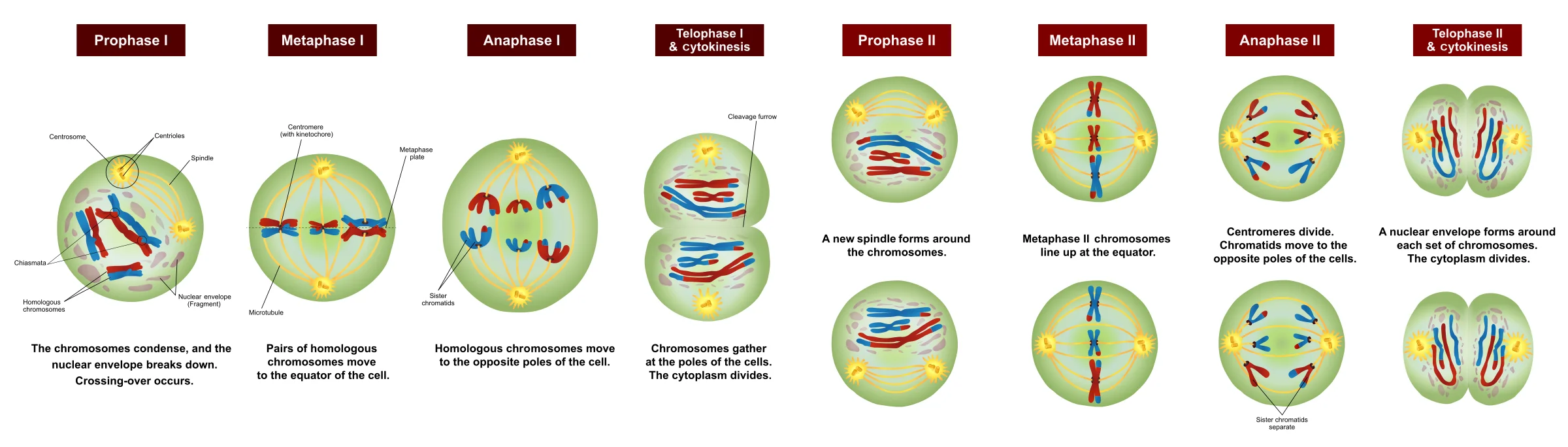
Meiosis consists of two divisions (Meiosis I and Meiosis II):
Meiosis I — separation of homologous pairs
- Homologous chromosomes pair up
- Crossing over occurs — sections of DNA exchange between chromosomes, creating new allele combinations
- Homologous pairs separate to opposite poles
Meiosis II — separation of sister chromatids
- Similar to mitosis; the two cells from Meiosis I divide again
- Sister chromatids separate
Outcome: 4 haploid cells, each genetically different from the others.
Meiosis I Stage Detail
Past papers have asked for events in named stages of Meiosis I:
| Stage | Key events |
|---|---|
| Prophase I | chromosomes condense; homologous chromosomes pair; crossing over may occur |
| Metaphase I | homologous pairs line up at the centre of the cell |
| Anaphase I | homologous chromosomes separate and move to opposite poles; sister chromatids remain joined |
| Telophase I | two nuclei/cells form, each with half the original chromosome number |
The most important distinction is that Meiosis I separates homologous chromosomes, while Meiosis II separates sister chromatids.
Sources of Genetic Variation in Meiosis
Two mechanisms create variation:
- Crossing over — during Meiosis I, homologous chromosomes exchange segments. This shuffles alleles, creating chromosomes with new combinations not present in either parent.
- Independent assortment — the orientation of each homologous pair at the cell centre is random. This means each gamete receives a random mix of maternal and paternal chromosomes.
These two mechanisms together produce enormous diversity in the gametes, even from the same two parents.
Mitosis vs Meiosis — Comparison
| Feature | Mitosis | Meiosis |
|---|---|---|
| Purpose | growth, repair, asexual reproduction | production of gametes (sexual reproduction) |
| Number of divisions | one | two |
| Cells produced | 2 | 4 |
| Chromosome number in products | diploid (2n) | haploid (n) |
| Genetic identity of products | identical to parent | genetically varied |
| Where it occurs | all body (somatic) cells | gonads (testes and ovaries) |
| Crossing over | does not occur | occurs during Meiosis I |
Exam Tip
A common exam question asks you to compare mitosis and meiosis. Focus on: number of divisions, chromosome number in daughter cells, and whether products are genetically identical or varied. These three points capture the key differences.
Link to Inheritance
The gametes produced by meiosis each carry one allele for every gene. When two gametes fuse at fertilisation, the zygote receives one allele from each parent — this is the basis of the inheritance patterns covered in the Heredity and Genetics page.