Cells and Cell Transport
Matthew Williams
||11 min read|Active TransportCellsCSEC BiologyDiffusionOsmosisSection B
Cell structure and organelles, plant vs animal cells, cell specialisation, diffusion, osmosis, active transport, and surface area to volume ratio.
The cell is the basic unit of life. Understanding how cells are built and how substances move in and out of them connects to almost every other topic in biology — from digestion and respiration to kidney function and plant nutrition.
Cell Structure
Plant and Animal Cells
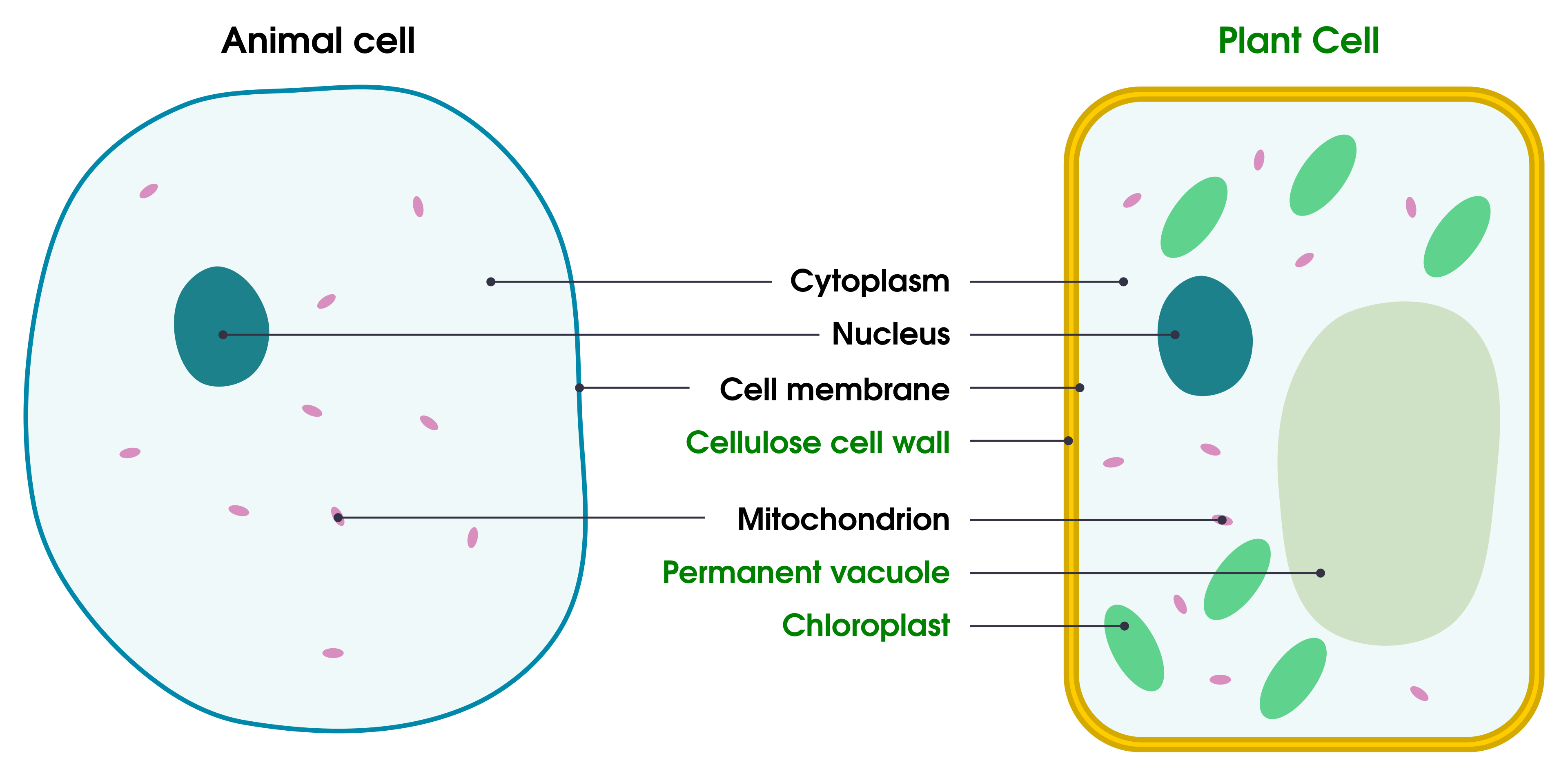
Both plant and animal cells share a set of core structures, but plant cells have additional features that support their role in photosynthesis and structural support.
| Structure | Animal cell | Plant cell | Function |
|---|---|---|---|
| Cell membrane | ✓ | ✓ | controls what enters and leaves the cell |
| Cytoplasm | ✓ | ✓ | site of many chemical reactions |
| Nucleus | ✓ | ✓ | contains DNA; controls cell activities |
| Mitochondria | ✓ | ✓ | site of aerobic respiration; releases ATP |
| Cell wall | ✗ | ✓ | made of cellulose; gives shape and support |
| Large vacuole | ✗ | ✓ | stores cell sap; maintains turgor pressure |
| Chloroplasts | ✗ | ✓ (in green cells) | contain chlorophyll; site of photosynthesis |
Remember
The three structures found in plant cells but not animal cells are the cell wall, large permanent vacuole, and chloroplasts.
Organelle Functions
| Organelle | Key function |
|---|---|
| Nucleus | carries genetic information as DNA on chromosomes; controls protein synthesis |
| Mitochondrion | releases energy from glucose through aerobic respiration |
| Chloroplast | absorbs light to drive photosynthesis; contains chlorophyll |
| Vacuole | in plant cells, stores water and dissolved substances; maintains firmness |
| Cell membrane | selectively permeable barrier; controls movement of substances |
| Ribosomes | site of protein synthesis (not visible without electron microscope) |
Microscopy and Biological Drawing
Past papers often test cells using micrographs or diagrams. When asked to draw a cell from a micrograph:
- draw a large, clear outline using single, unbroken pencil lines
- show only the structures you can actually see
- label with straight ruled lines that do not cross
- avoid shading, sketchy lines, colouring, or tiny drawings
- include a title if the question asks for one
If a question asks what type of microscope produced a highly detailed black-and-white image of internal cell structures, the likely answer is an electron microscope. Light microscopes show less detail and are commonly used for classroom slides.
Microbe Structures
Bacteria are prokaryotes — their genetic material is not enclosed in a true nucleus. A typical bacterium has:
- a nucleoid region containing DNA (circular, not bounded by a membrane)
- a cell wall (different composition from plant cell walls)
- a cell membrane beneath the wall
- a capsule in some species — protects the bacterium and helps it attach to host tissues
- flagella in some species — allow movement
- small ribosomes — make bacterial proteins
Exam Tip
To distinguish a spherical bacterium from an animal cell under a microscope, use cell organisation: a bacterium is much smaller, has no true nucleus, and may have a cell wall/capsule. An animal cell is larger and has a nucleus enclosed by a nuclear membrane.
Cell Specialisation
In a multicellular organism, cells become adapted for specific functions. This is called specialisation (or differentiation). Specialised cells work together in tissues, organs, and organ systems.
| Cell type | Adaptations | Function |
|---|---|---|
| Red blood cell | biconcave shape (large surface area); no nucleus (more space for haemoglobin); flexible membrane | carries oxygen in the blood |
| Root hair cell | long thin extension increases surface area; thin wall | absorbs water and mineral ions from soil |
| Palisade cell | packed with chloroplasts; near top of leaf for maximum light | site of most photosynthesis in the leaf |
| Sperm cell | long flagellum for movement; many mitochondria; acrosome to penetrate egg | delivers genetic material for fertilisation |
| Nerve cell (neurone) | very long axon; myelin sheath for speed | transmits electrical impulses rapidly |
Exam Tip
When asked to explain how a cell is adapted, always link the structural feature directly to how it helps the cell carry out its function. Saying "it has many mitochondria" is incomplete — add "which release energy for..."
Surface Area to Volume Ratio
As an organism grows larger, its volume increases faster than its surface area. This matters because substances must enter and leave through the surface.
A small organism like a bacterium has a very high surface area to volume ratio, so diffusion alone supplies its needs. A large organism such as a mammal has a much lower ratio — diffusion would be far too slow to deliver oxygen and nutrients to every cell. Large organisms therefore need specialised transport systems and exchange surfaces.
Biological structures that need rapid exchange are adapted to maximise surface area: alveoli in the lungs, villi in the small intestine, and root hair cells in plant roots all achieve this.
Diffusion
Diffusion is the net movement of particles from a region of higher concentration to a region of lower concentration, due to the random motion of particles. No energy is required.
Particles spread out because they are in constant random motion and collide less often on the less-crowded side. Over time, concentrations equalise — this state is called equilibrium. Diffusion continues at equilibrium, but there is no net movement.
What moves by diffusion in living systems
- Oxygen from the alveoli into the blood
- Carbon dioxide from the blood into the alveoli
- Glucose from the gut into the bloodstream
- Carbon dioxide out of cells during respiration
- Oxygen into cells for respiration
Factors affecting the rate of diffusion
| Factor | Effect on rate | Reason |
|---|---|---|
| Concentration gradient | steeper gradient → faster | more particles move from the concentrated side |
| Temperature | higher temperature → faster | particles have more kinetic energy |
| Surface area | larger surface area → faster | more area through which diffusion can occur |
| Diffusion distance | shorter distance → faster | particles reach the other side sooner |
| Particle size | smaller particles → faster | small particles move more quickly |
Osmosis
Osmosis is the movement of water molecules from a region of higher water potential to a region of lower water potential through a partially permeable membrane.
Water potential describes how freely water molecules can move. Pure water has the highest water potential. Adding a solute (such as sugar or salt) lowers the water potential of a solution, because solute particles interfere with the movement of water molecules. A dilute solution has higher water potential than a concentrated solution.
A partially permeable membrane allows water molecules to pass through but prevents most larger molecules from crossing. The cell membrane acts as a partially permeable membrane.
Effects on plant cells
| Condition | Result | Explanation |
|---|---|---|
| Placed in pure water or dilute solution | cell becomes turgid | water enters by osmosis; vacuole expands; membrane presses against cell wall |
| Placed in solution with same concentration as cell contents | no net water movement | water potential is equal on both sides |
| Placed in concentrated solution | cell becomes flaccid then plasmolysed | water leaves by osmosis; vacuole shrinks; membrane pulls away from cell wall |
Turgid plant cells provide support to soft tissues such as leaves and young stems. Plasmolysis causes wilting and is normally fatal if prolonged.
Effects on animal cells
Animal cells have no cell wall to resist pressure, so the effects are more extreme.
| Condition | Result |
|---|---|
| Placed in pure water or very dilute solution | swells and may lyse (burst) |
| Placed in solution with same concentration as cell contents | remains normal |
| Placed in concentrated solution | shrinks and crenates (shrivels) |
Tonicity
| Solution type | Solute concentration | Water movement | Effect on animal cell | Effect on plant cell |
|---|---|---|---|---|
| Hypotonic | lower than cell | into cell | swells / lyses | turgid |
| Isotonic | same as cell | no net movement | normal | slightly flaccid |
| Hypertonic | higher than cell | out of cell | crenates | plasmolysed |
Potato cylinder experiment
Potato cylinders are cut to equal length and mass, then placed in solutions of different salt or sugar concentrations. After a set time, the cylinders are re-weighed. Cylinders in dilute solutions gain mass (water entered); cylinders in concentrated solutions lose mass (water left). The concentration at which mass does not change is equal to the solute concentration inside the potato cells.
Exam Tip
Exam questions often give a table or graph from this experiment and ask you to: (1) identify the internal concentration of the potato, (2) explain the results in terms of water potential, or (3) calculate percentage change in mass. Always use "water potential" in your explanation — not just "concentration."
Active Transport
Active transport is the movement of substances from a region of lower concentration to a region of higher concentration — against the concentration gradient. This requires energy in the form of ATP, released by respiration.
Because active transport works against the natural direction of diffusion, carrier proteins in the cell membrane use ATP to move substances across. Any condition that reduces respiration (low oxygen, poisons that block respiration) will also slow active transport.
Examples of active transport in living systems
- Root hair cells absorb mineral ions (nitrates, phosphates, magnesium) from the soil even when the concentration inside the root is already higher than in the soil.
- Small intestine absorbs glucose and amino acids into the blood even when blood glucose is already high.
Comparing the Three Transport Processes
| Feature | Diffusion | Osmosis | Active transport |
|---|---|---|---|
| Substance moved | any dissolved particles or gases | water only | specific molecules or ions |
| Direction | high → low concentration | high → low water potential | low → high concentration |
| Energy required | no | no | yes (ATP from respiration) |
| Membrane required | not always | yes (partially permeable) | yes (carrier proteins) |
| Example | O₂ into cells, CO₂ out | water into root cells | mineral ions into root hairs |
RememberCore idea
Diffusion and osmosis are passive — they follow concentration gradients without energy. Active transport moves substances against gradients and requires ATP.