Classification and Ecology Basics
Matthew Williams
||11 min read|ClassificationCSEC BiologyEcologyEcosystemsSBASection A
The five kingdoms, ecological terms, biotic and abiotic factors, habitats, niches, limiting factors, and ecological sampling methods.
This page covers the starting point of Section A: how organisms are grouped, how ecologists describe the environment, and the vocabulary needed for food webs, population questions, and conservation topics.
Ecology questions often begin with definitions, then move into application. Strong answers name the term, explain it clearly, and link it to the example in the question.
Classification
Classification is the grouping of organisms based on shared features. It helps biologists identify organisms, compare them, and understand relationships among living things.
In field work, organisms may first be grouped using visible features. Useful features include hairiness, colour, shape, leaf venation, number of legs, number of wings, antennae, body covering, and body segmentation.
In a school garden, insects could be separated from spiders by counting legs: insects have six legs, while spiders have eight.
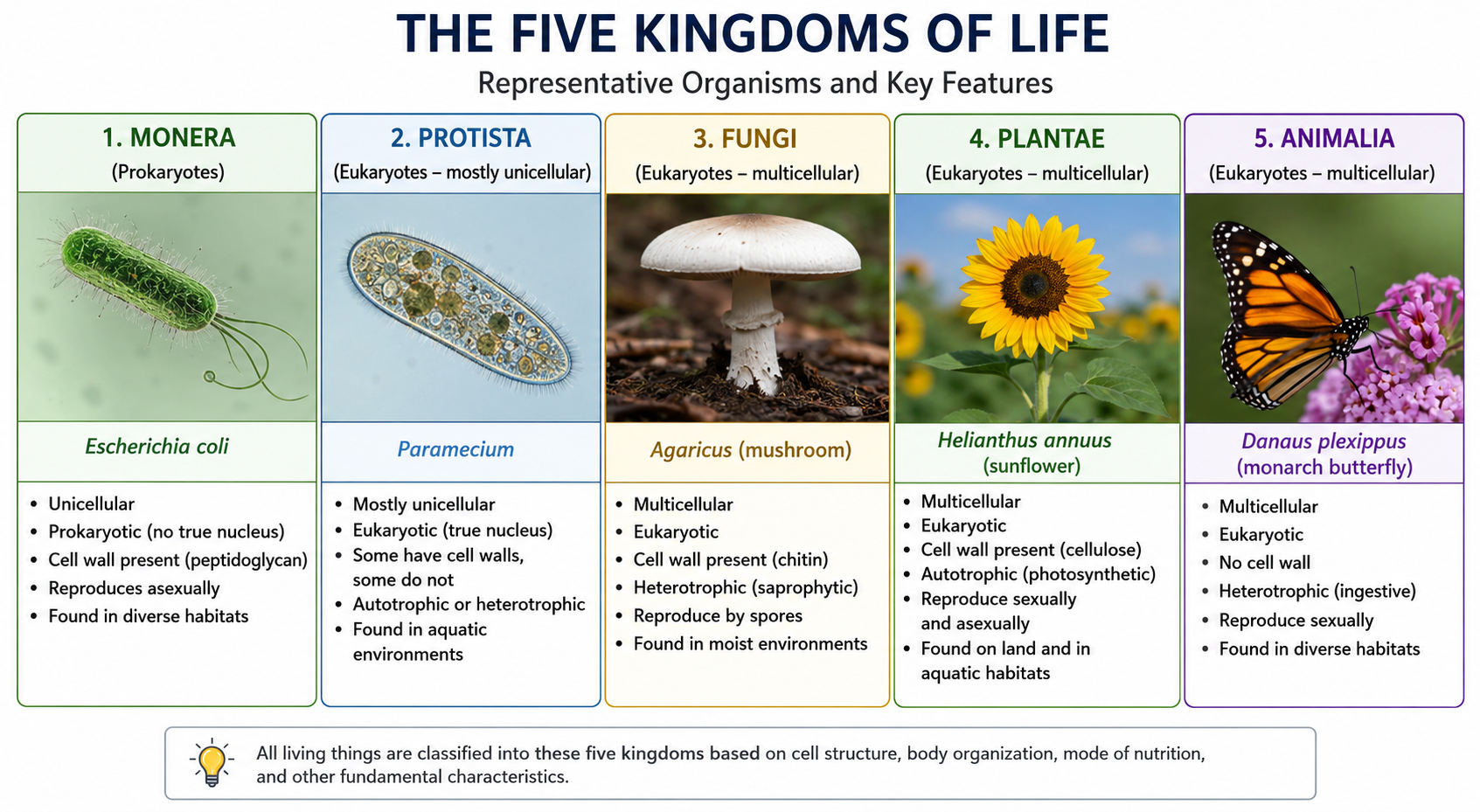
A useful starting point is the five-kingdom system:
| Kingdom | Main Features | Examples |
|---|---|---|
| Plantae | multicellular; cell walls; usually contain chlorophyll; make food by photosynthesis | flowering plants, mosses, ferns |
| Animalia | multicellular; no cell walls; cannot photosynthesise; usually move from place to place | humans, insects, fish, birds |
| Fungi | usually have cell walls; do not photosynthesise; absorb nutrients | mushrooms, moulds, yeast |
| Prokaryotae (Monera) | unicellular; no true nucleus | bacteria |
| Protoctista | mostly unicellular; have a nucleus; may be plant-like, animal-like, or fungus-like | Amoeba, algae, Paramecium |
InfoModern context: domains and the bacteria split
For CSEC, the expected system is the five-kingdom classification shown above. The syllabus names Prokaryotae (Bacteria) as one kingdom. In modern classification, the older Prokaryotae/Monera grouping is usually separated into two major prokaryotic groups: bacteria and archaea.
In modern biology, organisms are often placed first into three domains: Bacteria, Archaea, and Eukarya. This separates ordinary bacteria from Archaea, a different group of prokaryotes often associated with extreme environments such as hot springs or very salty lakes. The older kingdom Prokaryotae/Monera roughly corresponds to the prokaryotic domains Bacteria and Archaea, while Eukarya contains Protoctista, Fungi, Plantae, and Animalia.
| Modern Domain | Main Cell Type | Relationship to the Five-Kingdom System |
|---|---|---|
| Bacteria | prokaryotic; no true nucleus | part of the older Prokaryotae/Monera grouping |
| Archaea | prokaryotic; no true nucleus; biochemically distinct from bacteria | also part of the older Prokaryotae/Monera grouping, but separated in modern systems |
| Eukarya | cells have a true nucleus and membrane-bound organelles | includes Protoctista, Fungi, Plantae, and Animalia |
Exam Tip
If a CSEC question asks for the five kingdoms, give the five-kingdom answer: Plantae, Animalia, Fungi, Prokaryotae/Bacteria, and Protoctista. Use the three-domain system only if the question specifically asks about domains or modern classification.
Remember
Plants and fungi may both have cell walls, but fungi do not contain chlorophyll and do not photosynthesise.
Animal Kingdom Subdivisions
The Animal Kingdom can also be subdivided into phyla, then classes, then smaller groups down to species.
The order is:
For CSEC, the main skill is using visible features to place organisms into sensible groups. Features such as body segmentation, number of legs, wings, shell, backbone, and body covering are useful.
| Animal Group | Major Features | Examples |
|---|---|---|
| Cnidaria | simple aquatic animals; radial symmetry; tentacles with stinging cells; one body opening | jellyfish, sea anemone, coral, Hydra |
| Platyhelminthes | flat, soft bodies; no backbone | tapeworm, planarian |
| Annelida | segmented worms; no backbone | earthworm, leech |
| Mollusca | soft body; many have shells | snail, octopus, clam |
| Arthropoda | jointed legs; segmented body; exoskeleton | insects, spiders, crabs |
| Echinodermata | marine animals; spiny skin; tube feet; adults often show radial symmetry | starfish, sea urchin |
| Chordata | have a notochord at some stage; vertebrates have a backbone | fish, amphibians, reptiles, birds, mammals |
Arthropods are especially common in classification questions because their visible features are easy to compare.
| Arthropod Class | Useful Features | Examples |
|---|---|---|
| Insecta | three body parts; six legs; often wings | butterfly, beetle, grasshopper |
| Arachnida | two body parts; eight legs; no antennae | spider, scorpion |
| Crustacea | many have hard shells; usually two pairs of antennae | crab, shrimp |
| Myriapoda | long segmented body; many legs | centipede, millipede |
Chordates include the vertebrate classes students meet most often:
| Vertebrate Class | Useful Features | Examples |
|---|---|---|
| Fish | scales; fins; gills | snapper, tilapia |
| Amphibians | moist skin; young often live in water | frog, toad |
| Reptiles | dry scales; lungs | lizard, snake |
| Birds | feathers; wings; beak | hummingbird, chicken |
| Mammals | hair or fur; mammary glands | human, bat, dog |
In classification questions, the best feature is usually the one that separates organisms cleanly. Number of legs, wings, antennae, segmentation, and backbone are often more useful than colour.
Ecology
Ecology is the scientific study of interactions between organisms and their environment.
An environment includes:
- living factors, called biotic factors
- non-living factors, called abiotic factors
Biotic and Abiotic Factors
Biotic factors are the living parts of the environment, such as plants, animals, fungi, bacteria, and humans. Abiotic factors are the non-living parts, such as light intensity, temperature, water availability, soil type, pH, salinity, and air currents.
If mangrove seedlings grow poorly in very salty soil, salinity is an abiotic factor affecting their distribution.
Soil, Water, and Climate
Soil affects organisms because it provides water, mineral nutrients, oxygen for roots and soil organisms, anchorage, and different pH or salinity conditions. Air provides oxygen for respiration, carbon dioxide for photosynthesis, and nitrogen that can enter nutrient cycles through bacteria.
Light affects photosynthesis and activity patterns. Temperature affects enzyme-controlled reactions, growth, reproduction, and survival.
When an answer uses an abiotic factor, the effect matters: low light reduces photosynthesis, while very high salinity can make water uptake harder for plants.
Levels of Ecological Organisation
Ecology moves from one organism to the whole biosphere.
| Level | Meaning |
|---|---|
| Organism | one individual living thing |
| Population | members of one species living in the same place at the same time and able to interbreed |
| Community | all the interacting populations in an area |
| Ecosystem | a community plus the abiotic environment and the interactions between them |
| Biosphere | the life-supporting parts of Earth: land, air, fresh water, and salt water |
Habitat and Niche
A habitat is the place where an organism lives, such as a pond, forest, rotting log, coral reef, or mangrove swamp. A niche is the role a species plays in a community. It includes where the organism lives, what it eats, what eats it, when it is active, and how it affects other organisms.
A frog's habitat may be a pond. Its niche includes feeding on insects, being prey for birds and snakes, breeding in water, and helping to control insect populations.
Limiting Factors
A limiting factor is any biotic or abiotic factor that restricts the size, distribution, or survival of a population.
Common limiting factors include food, water, space, mates, temperature, predators, disease, and competition. When a population stops increasing, limiting factors are usually involved: food may run out, disease may spread more easily, or competition may become stronger.
Ecological Investigations
Ecologists use different tools and methods depending on the habitat and the organisms being studied. Choosing the right method matters: a quadrat works well for plants or slow-moving animals, but a sweep net or pitfall trap is better for mobile insects.
Sampling Methods
| Method | Best for | How it works |
|---|---|---|
| Quadrat | plants, slow invertebrates | place a square frame on the ground; count organisms inside; repeat at random positions |
| Line transect | distribution along a gradient | stretch a tape across the area; record every organism touching the line |
| Belt transect | distribution with detail | record all organisms within a fixed width on each side of the line |
| Pooter | small insects | suck air through a tube; insects enter a collection chamber |
| Sweep net | flying and vegetation insects | sweep through vegetation or air; collect organisms |
| Pitfall trap | ground-dwelling invertebrates | bury a container flush with the surface; animals fall in and cannot escape |
For plants, a quadrat can give percentage cover (how much of the frame is occupied) or density — the number of organisms per unit area sampled.
Mark-Release-Recapture
When animals move freely through a habitat, direct counting is difficult. The mark-release-recapture method estimates population size using the Lincoln index:
N = (M × C) ÷ R
- N — estimated population size
- M — number captured and marked in the first sample
- C — total number captured in the second sample
- R — number in the second sample that carry the original mark
Exam Tip
The Lincoln index assumes the marks do not affect survival, marks are not lost, the population does not change significantly between captures, and marked individuals mix fully with the rest of the population. Exam questions often ask you to state these assumptions or explain why a result might be inaccurate.
Quick Comparisons
| Pair Often Confused | Difference |
|---|---|
| Habitat and niche | habitat is where an organism lives; niche is its role |
| Population and community | population is one species; community is all populations in an area |
| Species and population | species refers to organisms that can interbreed to produce fertile offspring; population is members of one species living in a particular habitat |
| Biotic and abiotic | biotic is living; abiotic is non-living |
| Ecosystem and biosphere | ecosystem is one interacting system; biosphere is all life-supporting parts of Earth |
RememberCore idea
Classification groups organisms. Ecology explains how organisms live, interact, and respond to their environment.