Food Chains, Food Webs, and Energy Flow
Matthew Williams
||7 min read|CSEC BiologyEcologyEnergy FlowFood WebsSection A
Producers, consumers, decomposers, trophic levels, food chains, food webs, ecological pyramids, and bioaccumulation.
Feeding relationships show how organisms obtain energy and matter. In CSEC Biology, this topic often appears through food webs, trophic levels, ecological pyramids, and questions about what happens when one population changes.
Food chains should be studied in different habitats, including terrestrial and aquatic habitats.
| Habitat Type | Meaning | Examples |
|---|---|---|
| Terrestrial | land-based | forest floor, garden, tree |
| Arboreal | living mainly in trees | tree canopy |
| Edaphic | living in or on soil | leaf litter, soil surface |
| Aquatic | water-based | pond, river, sea |
| Marine | salt water | coral reef, seagrass bed |
| Freshwater | fresh water | pond, stream |
Producers, Consumers, and Decomposers
Producers make their own food. They are autotrophs, such as green plants, algae, phytoplankton, and mosses. Producers are important because they trap light energy from the sun and convert it into chemical energy in food.
Consumers cannot make their own food. They are heterotrophs.
| Consumer Type | Feeding Pattern | Example |
|---|---|---|
| Herbivore | eats plants | grasshopper |
| Carnivore | eats animals | hawk |
| Omnivore | eats plants and animals | human |
| Decomposer | breaks down dead matter and waste | bacteria, fungi |
In exam questions, herbivores, carnivores, and omnivores may come from unfamiliar habitats. Work from what the organism eats, not from whether the animal is familiar.
Decomposers break down dead plants, dead animals, and waste materials. Bacteria and fungi are the main decomposers.
Detritivores feed on decomposing organic matter. Examples include earthworms and dung beetles. Decomposers return nutrients to the environment; without them, nutrients would stay trapped in dead organisms and producers would eventually lack minerals for growth.
Trophic Levels
A trophic level is a feeding position in a food chain or food web.
| Trophic Level | Role | Example |
|---|---|---|
| First | producer | grass |
| Second | primary consumer | grasshopper |
| Third | secondary consumer | lizard |
| Fourth | tertiary consumer | hawk |
Food Chains
A food chain shows the transfer of energy and matter from one organism to another.
Example: Grass → grasshopper → lizard → hawk. Grass is the producer, grasshopper is the primary consumer, lizard is the secondary consumer, and hawk is the tertiary consumer. The arrow means "is eaten by" or "energy passes to", so it points in the direction of energy transfer.
Food Webs
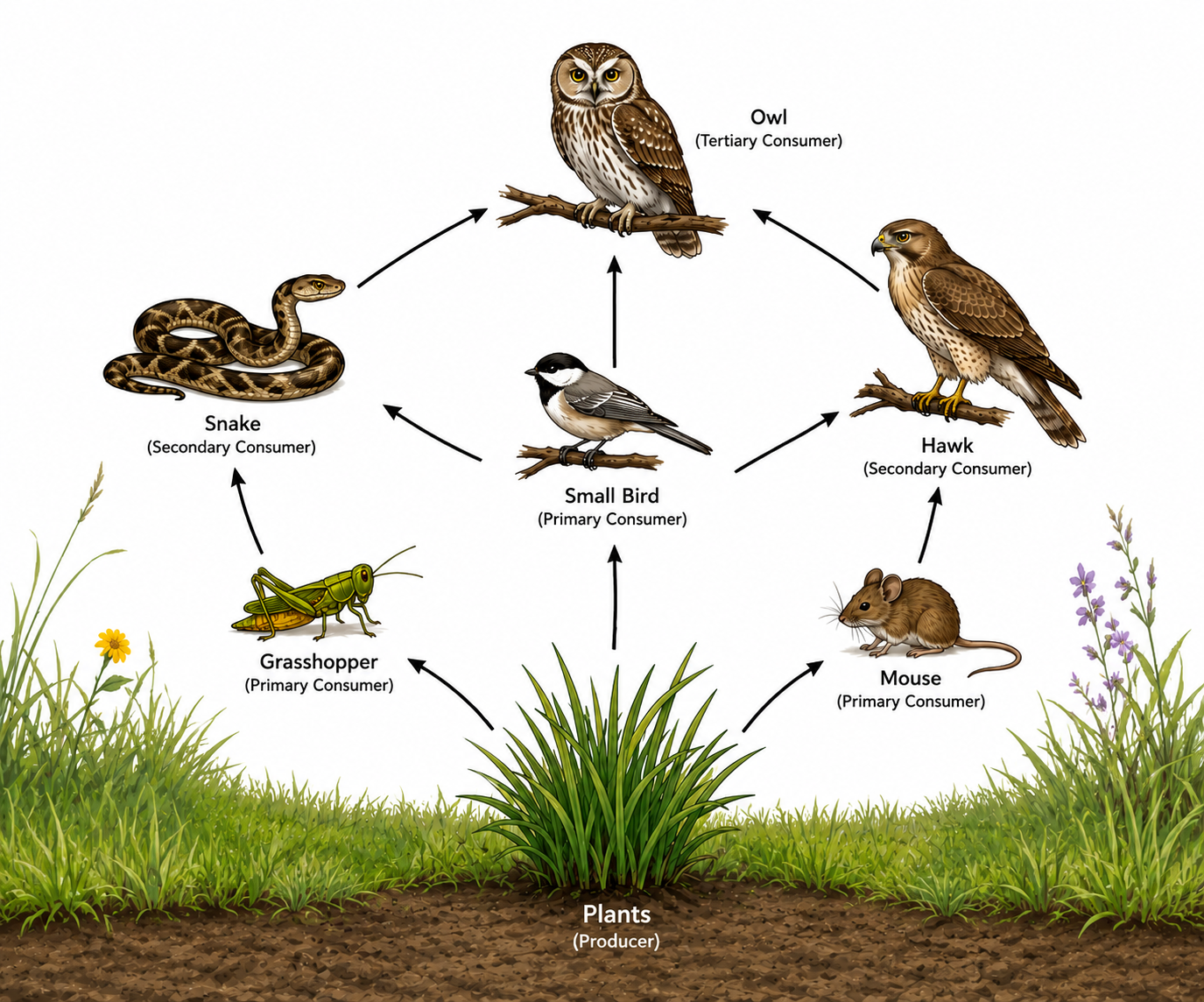
A food web is a network of interconnected food chains. It is more realistic than a single food chain because most organisms feed on more than one type of food.
Interdependence
Organisms in a food web are interdependent. A change in one population can affect several others.
If grasshoppers decrease:
- lizards may have less food
- small birds may have less food
- grass may increase because fewer grasshoppers feed on it
- hawks may be affected indirectly if their prey decrease
Food web answers are strongest when they follow the arrows carefully and explain both direct and indirect effects.
Predator, Prey, and Biological Control
A predator hunts, kills, and eats another organism. The organism eaten is the prey.
Predator-prey relationships can be used in biological control, where a living organism is used to reduce the population of a pest.
ExampleBiological control
If a pest insect damages crops, a predator or parasite of that insect may be introduced or encouraged to reduce the pest population. This can reduce the need for chemical pesticides, but it must be managed carefully so the control organism does not become a new problem.
Energy Flow
Energy flow is non-cyclic. Energy enters most ecosystems as sunlight, moves through food chains, and leaves as heat.
Sunlight → producers → consumers → decomposers → heat loss
Energy decreases at each trophic level because organisms use energy for movement, respiration, growth and repair, reproduction, temperature regulation, excretion, and waste. Not all parts of an organism are eaten or digested, and some energy remains in dead material and waste where decomposers act on it.
Remember
Matter cycles through ecosystems, but energy flows through ecosystems and is eventually lost as heat.
Ecological Pyramids
Ecological pyramids show relationships between trophic levels.
| Pyramid Type | What It Shows | Key Point |
|---|---|---|
| Energy | energy available at each trophic level | always upright |
| Biomass | dry mass of organisms at each trophic level | usually upright |
| Numbers | number of organisms at each trophic level | may be irregular |
Example energy pattern:
| Trophic Level | Energy Available |
|---|---|
| Producers | 10,000 J |
| Primary consumers | 1,000 J |
| Secondary consumers | 100 J |
| Tertiary consumers | 10 J |
A pyramid of numbers may be unusual. One oak tree can support many greenflies, so the producer level may contain fewer organisms than the consumer level.
The pyramid of energy is the best pyramid for showing energy transfer because it accounts for energy loss between trophic levels.
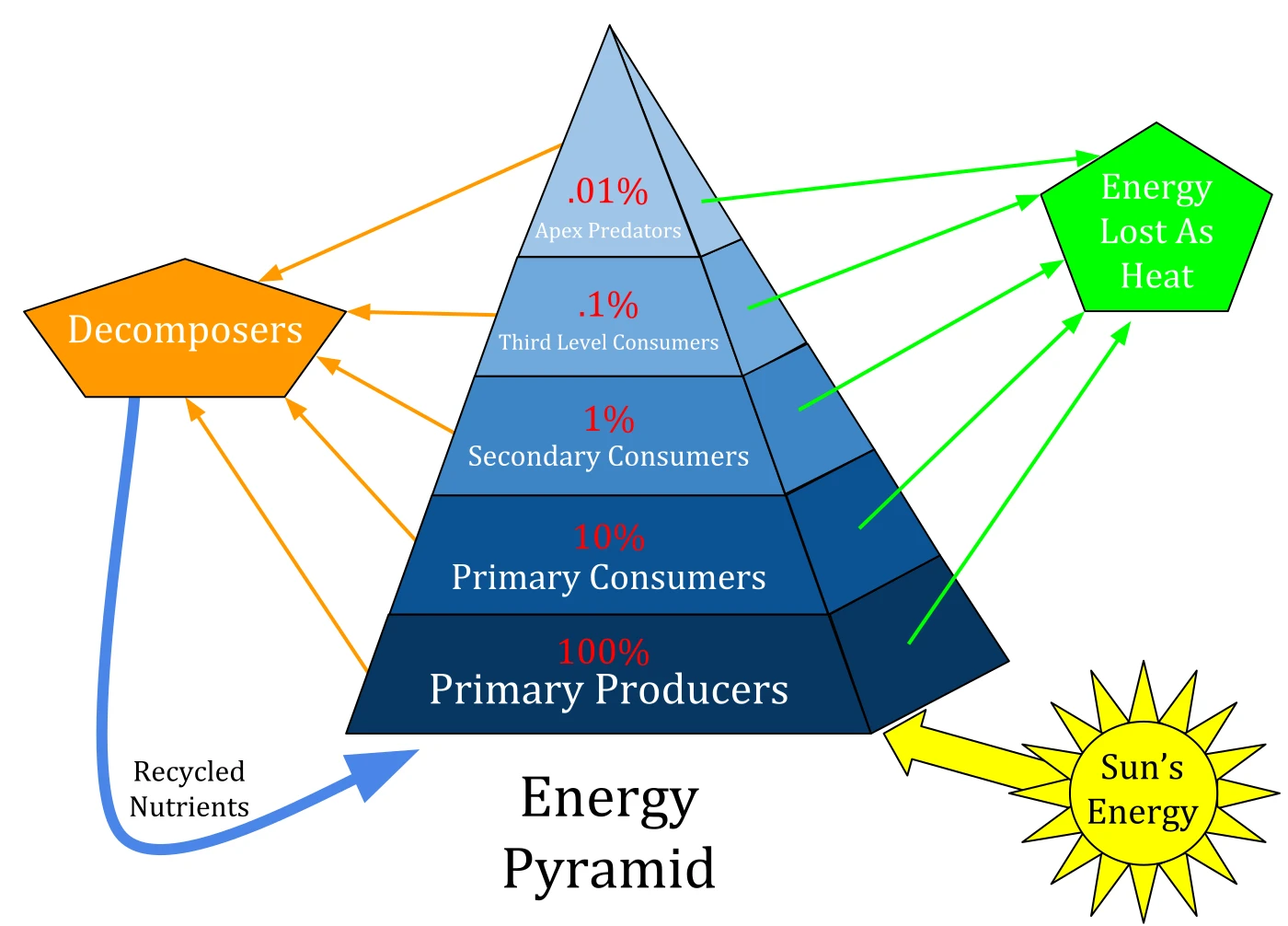
At each trophic level roughly 10% of the energy is passed on — the other 90% is lost through respiration (heat), movement, excretion, and material that is not eaten or digested. This is why food chains rarely exceed four or five links: too little energy remains at the top to support another level.
Bioaccumulation
Bioaccumulation is the build-up of toxic substances in the tissues of organisms. These substances may become more concentrated at higher trophic levels because predators eat many contaminated prey.
Examples:
- DDT built up in birds of prey and caused thin eggshells
- mercury can build up in large predatory fish
RememberCore idea
Energy becomes less available up a food chain, while persistent pollutants may become more concentrated.