Heredity and Genetics
Detailed notes on heredity and genetics covering Mendelian inheritance, genetic variation, and analysis techniques
Genetics is the branch of biology concerned with how characteristics are passed from one generation to the next. This transmission of traits occurs through structures known as genes, which are located on chromosomes within the nucleus of cells. Understanding genetics allows us to explain patterns of inheritance, variation among individuals, and the biological basis of traits.
Fundamental Genetic Concepts
At the core of genetics are several essential terms that must be clearly understood.
A gene is a unit of inheritance responsible for a particular characteristic. Each gene can exist in different forms known as alleles. For example, a gene controlling height in plants may have one allele for tallness and another for dwarfness.
When an organism possesses two identical alleles for a trait, it is described as homozygous. If the alleles differ, the organism is heterozygous. The actual genetic composition is referred to as the genotype, while the outward expression of that genetic information is the phenotype.
A dominant allele is expressed in the phenotype even when only one copy is present, whereas a recessive allele is only expressed when two copies are present and no dominant allele is present.
Mendelian Inheritance
The foundation of classical genetics was established by Gregor Mendel through his experiments with pea plants. By carefully controlling crosses between plants with contrasting characteristics, Mendel was able to observe consistent patterns in inheritance.
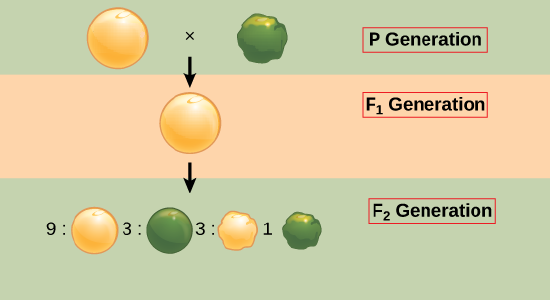
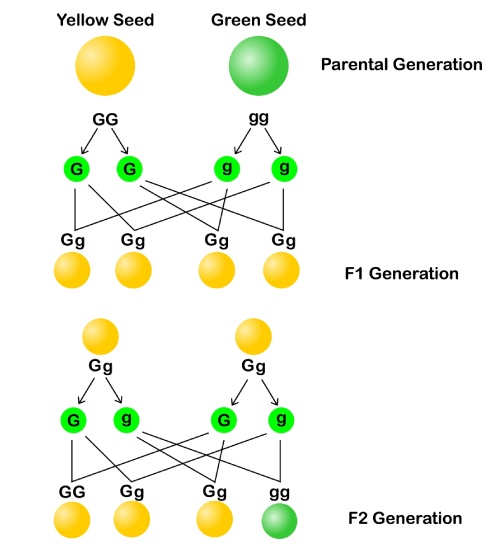
When a pure-breeding tall plant (TT) was crossed with a pure-breeding dwarf plant (tt), all offspring in the first generation (F1) were tall. This indicated that the allele for tallness was dominant.
However, when these F1 plants were crossed with each other, the second generation (F2) displayed a ratio of approximately three tall plants to one dwarf plant. This 3:1 ratio is a key result in monohybrid inheritance.
From these observations, Mendel proposed the Law of Segregation, which states that allele pairs separate during gamete formation so that each gamete carries only one allele. During fertilisation, these alleles recombine randomly.
Genetic Crosses and Punnett Squares
To predict the outcome of genetic crosses, a method known as the Punnett square is used. This tool allows the possible combinations of alleles from each parent to be visualised.
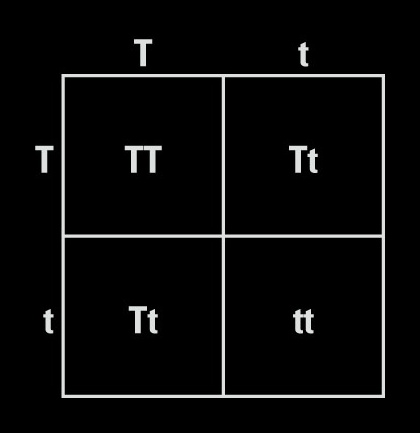
For example, when two heterozygous individuals (Tt × Tt) are crossed, the resulting genotypes are:
- TT
- Tt
- Tt
- tt
This produces a genotype ratio of 1:2:1 and a phenotype ratio of 3:1.
It is important to understand that these ratios represent probabilities, not guaranteed outcomes. In real populations, deviations may occur due to chance, environmental factors, or differential survival rates.
Variation in Expected Ratios
Although Mendelian ratios provide a theoretical expectation, actual results may differ. This is because fertilisation is a random process, and in small sample sizes, random variation can significantly affect observed outcomes. Additionally, not all offspring may survive to maturity, further altering the ratios.
Extensions of Monohybrid Inheritance
While simple dominance explains many traits, there are important variations that must be understood.
Test Cross
A test cross is used to determine the genotype of an organism displaying a dominant phenotype. The organism is crossed with a homozygous recessive individual.
If all offspring display the dominant trait, the unknown genotype is homozygous dominant. If a 1:1 ratio appears, the organism is heterozygous.
Incomplete Dominance
In some cases, neither allele is completely dominant. This results in incomplete dominance, where the heterozygous phenotype is intermediate between the two homozygous forms.
A classic example is the snapdragon flower:
- Red × White → Pink
When two pink flowers are crossed, the ratio becomes:
- 1 Red : 2 Pink : 1 White
Codominance
In codominance, both alleles are expressed equally in the phenotype. Neither allele masks the other.
An example is seen in certain cattle, where red and white alleles produce offspring with both red and white hairs. Another important example is human blood groups.
Multiple Alleles
Some genes exist in more than two forms within a population. These are known as multiple alleles.
The ABO blood group system is a key example:
- IA and IB are codominant
- IO is recessive
This results in four possible blood groups: A, B, AB, and O.
Sex Determination in Humans
In humans, sex is determined by a pair of chromosomes known as the sex chromosomes.
Females possess two X chromosomes (XX), while males possess one X and one Y chromosome (XY). During reproduction, the egg always contributes an X chromosome, while the sperm may contribute either an X or a Y.
This results in an equal probability of producing male or female offspring.
Pedigree Analysis
A pedigree chart is used to trace the inheritance of a trait through multiple generations of a family. It provides valuable information about whether a trait is dominant or recessive.
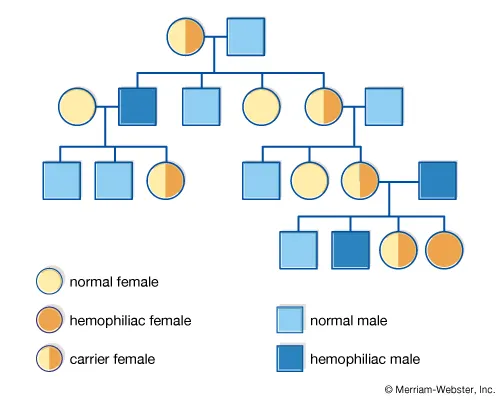
Certain patterns help in interpretation:
- If two unaffected parents produce an affected child, the trait is recessive.
- If a trait appears in every generation, it is likely dominant.
- If a trait skips generations, it is typically recessive.
Pedigree analysis is especially important in studying inherited diseases.
Summary of Key Principles
Genetics is governed by predictable patterns, but these patterns must be interpreted correctly.
- Traits are controlled by genes located on chromosomes.
- Alleles determine variations in traits.
- Dominance relationships affect how traits are expressed.
- Genetic crosses can be used to predict inheritance patterns.
- Real-world results may differ from expected ratios due to chance and environmental factors.
A strong understanding of these principles is essential for solving genetic problems and interpreting biological data.
Examination Application
To perform well in examinations, you must be able to:
- Accurately define and use genetic terminology
- Construct and interpret Punnett squares
- Solve inheritance problems involving monohybrid crosses
- Distinguish between types of dominance
- Analyse pedigree charts logically
Mastery of these skills ensures success in both structured and extended-response questions.