Human Nutrition and Digestion
Matthew Williams
||11 min read|CSEC BiologyDigestionEnzymesNutritionSection B
Nutrients and their functions, food tests, tooth structure, the alimentary canal, enzymes, absorption in the small intestine, and balanced diet requirements.
Humans are heterotrophs — they obtain energy and materials by consuming other organisms. The digestive system breaks down complex food molecules into forms small enough to be absorbed and used by cells.
The five stages of nutrition in animals are:
Ingestion → Digestion → Absorption → Assimilation → Egestion
- Ingestion — taking food into the body through the mouth
- Digestion — breaking down large molecules into smaller ones (mechanically and chemically)
- Absorption — passing digested molecules from the gut into the blood or lymph
- Assimilation — using absorbed molecules in the cells for energy, growth, or repair
- Egestion — removing undigested material from the body as faeces
Exam Tip
Egestion and excretion are different. Egestion removes undigested material that was never absorbed. Excretion removes metabolic waste products that were produced inside the body (such as urea and CO₂). Faeces is egested; urine is excreted.
Nutrients
Carbohydrates
Carbohydrates are the body's main source of energy. They are made of carbon, hydrogen, and oxygen.
| Type | Examples | Sources |
|---|---|---|
| Monosaccharides (simple sugars) | glucose, fructose | fruits, some vegetables |
| Disaccharides | sucrose, maltose, lactose | table sugar, malt, milk |
| Polysaccharides | starch, glycogen, cellulose | bread, rice, pasta, potatoes |
Starch is the main storage carbohydrate in plants. Glycogen is the storage form in animals (in the liver and muscle). Cellulose forms plant cell walls and provides dietary fibre.
Proteins
Proteins are built from amino acids. The body needs them for growth, repair, enzyme production, hormone synthesis, and building structures such as muscle and cell membranes. Proteins contain carbon, hydrogen, oxygen, and nitrogen.
Sources include meat, fish, eggs, dairy, beans, and nuts. The body cannot store excess amino acids — the nitrogen-containing portion is removed in the liver (deamination) and excreted as urea.
Lipids
Lipids (fats and oils) provide long-term energy storage, insulate the body, protect organs, form cell membranes, and carry fat-soluble vitamins (A, D, E, K). Sources include butter, oils, nuts, avocados, and fatty fish.
Vitamins
Vitamins are organic compounds needed in small amounts.
| Vitamin | Function | Sources | Deficiency disease |
|---|---|---|---|
| A | vision in dim light; healthy skin and cell growth | liver, dairy, carrots, leafy vegetables | night blindness |
| C | wound healing; healthy gums, skin, and blood vessels; antioxidant | citrus fruits, peppers, guava | scurvy (bleeding gums, slow healing) |
| D | absorption of calcium for bones and teeth | oily fish, eggs, liver, sunlight on skin | rickets (soft, deformed bones in children) |
Minerals
Minerals are inorganic ions needed in small amounts.
| Mineral | Function | Sources | Deficiency |
|---|---|---|---|
| Calcium | bones, teeth, blood clotting, muscle contraction | dairy, leafy vegetables, sardines | weak bones, poor clotting |
| Iron | making haemoglobin in red blood cells | red meat, liver, spinach, legumes | anaemia (fatigue, pale skin, breathlessness) |
Fibre, Water
Fibre (mainly cellulose from plant material) cannot be digested, but it adds bulk to food, stimulates peristalsis, prevents constipation, and may reduce the risk of bowel cancer. Sources: vegetables, whole grains, fruits.
Water is a solvent for reactions, transports substances in blood, regulates temperature through sweating, and is needed for all metabolic processes. It is continuously lost through urine, sweat, breathing, and faeces.
Food Tests
These tests identify which food substances are present in a sample.
| Substance | Reagent | Method | Positive result |
|---|---|---|---|
| Starch | Iodine solution | add iodine drops to sample | blue-black colour |
| Reducing sugars (e.g. glucose, maltose) | Benedict's solution | add Benedict's, heat in water bath | brick-red/orange/yellow precipitate |
| Non-reducing sugars (e.g. sucrose) | Benedict's after acid hydrolysis | add dilute HCl, heat; cool; neutralise with NaHCO₃; add Benedict's, heat | brick-red precipitate |
| Protein | Biuret reagent | add Biuret reagent to sample | lilac/purple colour |
| Lipid | Ethanol emulsion test | dissolve sample in ethanol; pour into water | milky white emulsion |
Exam Tip
For the non-reducing sugar test, the acid breaks the disaccharide into monosaccharides (which are reducing sugars). The solution must be neutralised before adding Benedict's because the test only works in alkaline conditions.
The Alimentary Canal
Food travels from mouth to anus through the alimentary canal. Each region has a specialised role.
| Region | Main events |
|---|---|
| Mouth | mechanical digestion by teeth; salivary amylase begins starch digestion |
| Oesophagus | peristalsis moves food to stomach; no digestion |
| Stomach | muscular walls churn food; pepsin (in acidic conditions, pH 2) begins protein digestion; hydrochloric acid kills pathogens |
| Small intestine (duodenum) | bile from liver emulsifies fats; pancreatic juice (amylase, lipase, proteases) continues digestion |
| Small intestine (ileum) | final digestion; absorption of glucose, amino acids, fatty acids, glycerol, vitamins, minerals, and water into blood and lymph |
| Large intestine | water and mineral ions reabsorbed; remaining material forms faeces |
| Rectum / Anus | faeces stored then egested |
Tooth Structure and Mastication
Teeth break food into smaller pieces — a process called mastication (mechanical digestion). This increases the surface area for enzymes to act on.
| Part | Description |
|---|---|
| Enamel | hardest substance in the body; covers the crown; protects dentine |
| Dentine | hard but slightly flexible layer beneath enamel; forms the bulk of the tooth |
| Pulp cavity | contains nerves and blood vessels; supplies the tooth with nutrients |
| Cement | attaches the root to the jawbone |
| Root | embedded in the jawbone; holds the tooth in place |
| Gum (gingiva) | soft tissue surrounding the tooth at the jawline |
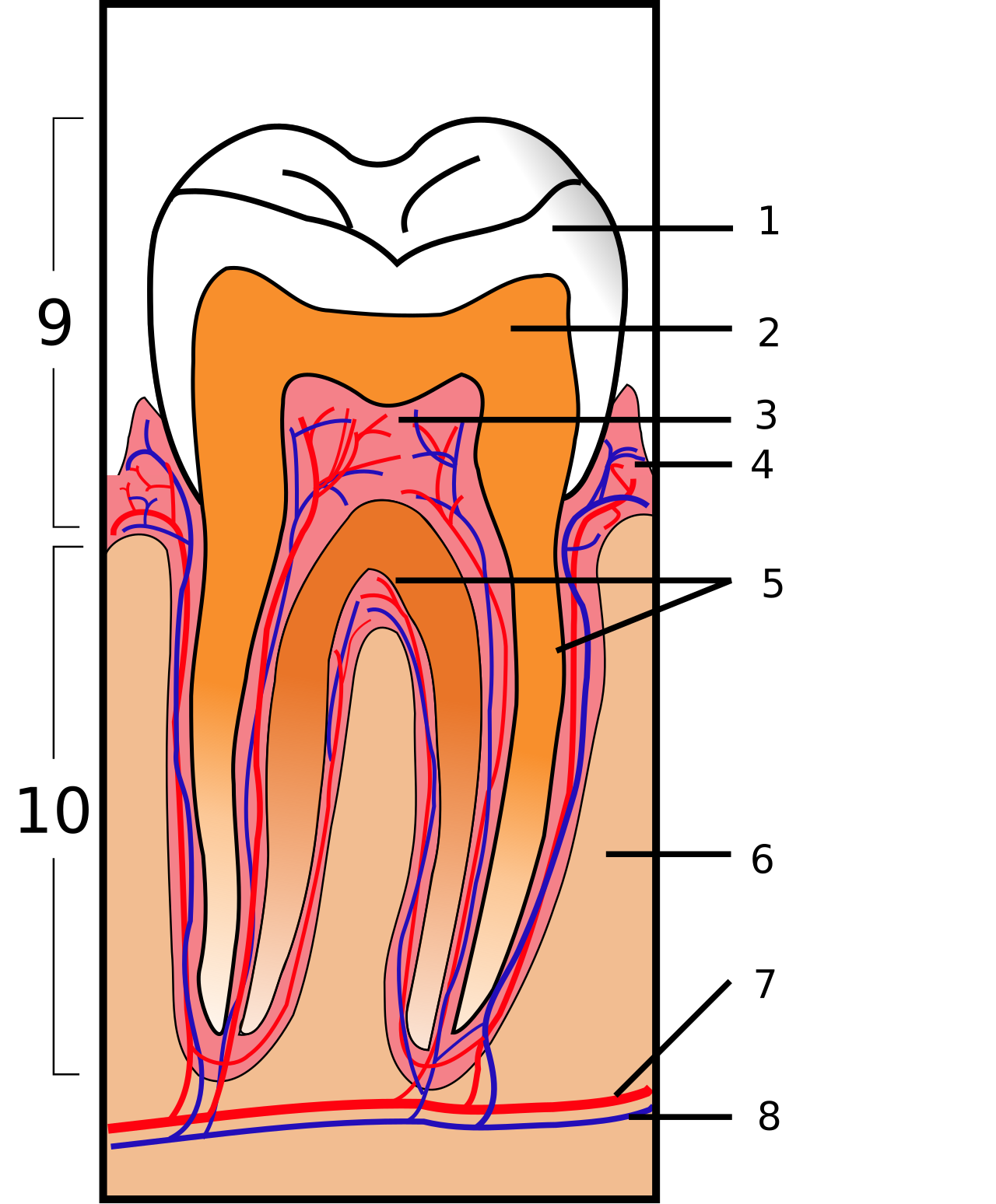
Key1.Enamel2.Dentine3.Gum (gingiva)4.Pulp cavity5.Cementum6.Root7.Blood vessels8.Nerve9.Crown (region)10.Root (region)
Humans have different tooth types suited to different functions: incisors (bite and cut), canines (tear), premolars and molars (crush and grind).
Exam Tip
Exam questions often ask you to label a tooth diagram or link a tooth region to its function. Remember: enamel is the hardest layer and is on the outside (crown); the pulp cavity contains the nerve and blood supply.
Peristalsis
Food moves through the gut by peristalsis — wave-like contractions of circular and longitudinal muscle layers in the gut wall. This squeezes food along the tube regardless of body position.
Enzymes in Digestion
Enzymes are biological catalysts that speed up chemical reactions. They are specific — each enzyme acts on one type of substrate.
| Enzyme | Produced by | Substrate | Product | pH optimum |
|---|---|---|---|---|
| Salivary amylase | salivary glands | starch | maltose | ~7 (neutral) |
| Pepsin | stomach wall | proteins | peptides | ~2 (acidic) |
| Pancreatic amylase | pancreas | starch | maltose | ~7–8 |
| Trypsin | pancreas | proteins/peptides | peptides/amino acids | ~8 |
| Lipase | pancreas | lipids | fatty acids + glycerol | ~7–8 |
| Maltase | small intestine wall | maltose | glucose | ~7 |
Effect of temperature on enzyme activity
As temperature rises, enzyme and substrate molecules collide more often and reactions speed up. Above the optimum temperature (~37–40°C in humans), the enzyme's shape distorts — it is denatured — and activity falls sharply. The effect is permanent.
Effect of pH
Each enzyme has an optimum pH. Pepsin works in the acidic stomach (pH 2), while pancreatic enzymes work in the alkaline duodenum (pH 7–8). Moving away from the optimum changes the shape of the active site and reduces activity.
Enzyme Investigation Skills
Past papers often ask about enzyme experiments using potato catalase or protease. For a temperature investigation:
- use equal amounts or sizes of enzyme source, such as the same mass of crushed potato
- use the same volume and concentration of substrate in each tube
- place tubes in water baths at different temperatures
- measure the reaction rate using a consistent method, such as bubbles per minute or time taken for a product to appear
- repeat readings and calculate a mean if possible
The graph usually rises as temperature increases because molecules have more kinetic energy and collide more often. Activity falls after the optimum because the enzyme denatures and its active site changes shape.
To test pH instead, keep temperature constant and use buffer solutions of different pH values. The best pH is the one with the fastest reaction rate.
Role of bile
Bile is produced in the liver, stored in the gall bladder, and released into the duodenum. It contains bile salts that emulsify fats — breaking large fat droplets into tiny ones. This greatly increases the surface area available for lipase to act on.
Absorption in the Small Intestine
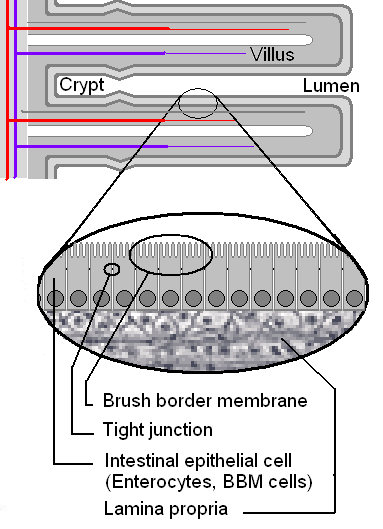
Absorption happens mainly in the ileum. The inner wall is folded into finger-like projections called villi, which are further folded at the microscopic level into microvilli (the brush border). This massively increases surface area.
| Adaptation of villi | Benefit |
|---|---|
| Large number of villi and microvilli | greatly increases surface area for absorption |
| Single layer of epithelial cells | very short diffusion distance |
| Rich capillary network | carries absorbed glucose and amino acids away quickly, maintaining concentration gradient |
| Lacteal (lymph vessel) | absorbs fatty acids and glycerol (as chylomicrons) into the lymph system |
After absorption:
- Glucose and amino acids pass into capillaries → hepatic portal vein → liver
- Fatty acids and glycerol are reassembled into fats → enter lacteals → lymph system → bloodstream
Assimilation of Glucose
Assimilation means using absorbed nutrients in body cells. After glucose is absorbed into the blood, it may be:
- respired by cells to release energy
- stored as glycogen in the liver and muscles
- converted to fat if there is more than the body needs
Insulin helps a non-diabetic person remove excess glucose from the blood by increasing uptake into cells and conversion to glycogen. In diabetes, insulin is absent or ineffective, so blood glucose remains too high unless managed by diet, exercise, medication, or insulin injections.
Balanced Diet and Malnutrition
A balanced diet contains all necessary nutrients in proportions that maintain health — it is not just about eating all nutrient types, but getting the right amounts.
Different individuals need different amounts based on age, sex, activity level, pregnancy, and growth stage.
| Group | Why requirements differ |
|---|---|
| Children and teenagers | high protein and calcium needs; rapid growth |
| Pregnant women | extra iron, calcium, and protein for foetal development |
| Manual workers / athletes | higher energy (carbohydrate and fat) intake |
| Elderly | may need more calcium and vitamin D; lower total energy |
Malnutrition is poor nutrition caused by deficiency, excess, or imbalance of nutrients — not just starvation.
- Undernutrition — too little energy or nutrients: leads to wasting, kwashiorkor (protein deficiency), or specific deficiency diseases
- Overnutrition — excess energy intake: leads to obesity, increased risk of heart disease, type 2 diabetes, and hypertension