Variation
Matthew Williams
||10 min read|CSEC BiologyEvolutionGenetic EngineeringMutationNatural SelectionSection CSpeciationVariation
Continuous and discontinuous variation, natural selection, mutation types, the species concept, speciation, artificial selection, and genetic engineering applications.
Variation refers to the differences observed among individuals of the same species. These differences may be physical, physiological, or behavioural, and arise from two sources: genetic factors (inherited, passed from parent to offspring) and environmental influences (acquired during an organism's lifetime, not inherited). Variation matters because it allows populations to adapt when conditions change — without it, a single environmental pressure could eliminate an entire population.
Types of Variation
Variation is classified into two types based on how traits are distributed within a population.
Discontinuous variation produces clearly defined categories with no intermediates. Each individual either has a trait or does not. These traits are controlled by one or a few genes, and environmental influence is minimal.
Examples: blood group, tongue rolling, earlobe attachment (free or attached).
Continuous variation produces a gradual range between two extremes, with no clear categories. These traits are controlled by many genes acting together — polygenic inheritance — and are significantly influenced by environment.
Examples: height, body mass, skin colour, intelligence.
In populations, continuously varying traits follow a normal distribution: most individuals cluster near the average, with fewer at either extreme.
Discontinuous vs continuous variation
| Feature | Discontinuous | Continuous |
|---|---|---|
| Categories | Distinct, no intermediates | Gradual range between extremes |
| Gene control | One or a few genes | Many genes (polygenic) |
| Environmental influence | Minimal | Significant |
| Distribution graph | Bar chart (separate categories) | Histogram / bell curve |
| Examples | Blood group, tongue rolling | Height, body mass, skin colour |
Exam Tip
Exam questions often ask how to represent each type of variation graphically. Discontinuous variation → bar chart with gaps between bars (discrete groups). Continuous variation → histogram or frequency polygon (no gaps, normal distribution shape). Being specific about graph type earns marks.
Genetic vs Environmental Influence
An organism's phenotype is the product of its genotype and its environment. Genetic variation is heritable; environmental variation is not. Two genetically identical plants grown under different light conditions may differ noticeably in height — that difference is environmental, not genetic, and cannot be passed on.
Natural Selection
Natural selection is the process by which traits that improve survival and reproduction become more common in a population over generations. It requires four conditions:
- Organisms produce more offspring than can survive
- Competition exists for limited resources (food, space, mates)
- Individuals within the population show heritable variation
- Some variations provide a survival or reproductive advantage
Exam Tip
"Fitness" in biology means reproductive success — not physical strength. A fit organism is simply one that survives long enough to reproduce and pass on its alleles. This distinction is commonly tested.
Sources of Variation
Natural selection acts on variation produced by three biological processes:
- Independent assortment during meiosis shuffles chromosome combinations into gametes
- Crossing over exchanges segments between homologous chromosomes, creating new allele combinations
- Mutations introduce entirely new alleles into the gene pool
Examples in Practice
Peppered moths: Before industrialisation, pale moths blended into lichen-covered bark and survived better. Pollution darkened tree surfaces, and dark moths gained a camouflage advantage — their frequency rose while pale moths declined. Pollution controls later reversed this.
Antibiotic-resistant bacteria: Within a bacterial population, some individuals carry mutations that confer resistance. Antibiotic treatment kills susceptible bacteria while resistant ones survive and reproduce. The result is a population dominated by resistant strains — which is why completing antibiotic courses matters.
Natural Selection and Evolution
Over long periods, accumulated changes driven by natural selection can produce new species. Darwin's finches in the Galápagos are the textbook example: different beak shapes evolved to exploit different food sources across islands, driven by different selective pressures — a process called adaptive radiation.
Mutation
A mutation is a random, spontaneous change in genetic material. Mutations are the ultimate source of new alleles in a population and can occur at two levels.
Types of mutation
| Type | Description | Example |
|---|---|---|
| Gene mutation | Change in the DNA base sequence | Sickle-cell anaemia, albinism |
| Chromosomal mutation | Change in chromosome number or structure | Down's syndrome (trisomy 21) |
Mutations in body cells affect only that individual. Mutations in gametes can be inherited.
Most mutations are neutral or harmful. A beneficial mutation is rare but provides a selective advantage — and if the environment favours it, natural selection will increase its frequency.
Genetic Conditions Caused by Mutation
Albinism results from a recessive allele that prevents melanin production. Individuals lack pigmentation in skin, hair, and eyes, and are highly sensitive to UV light.
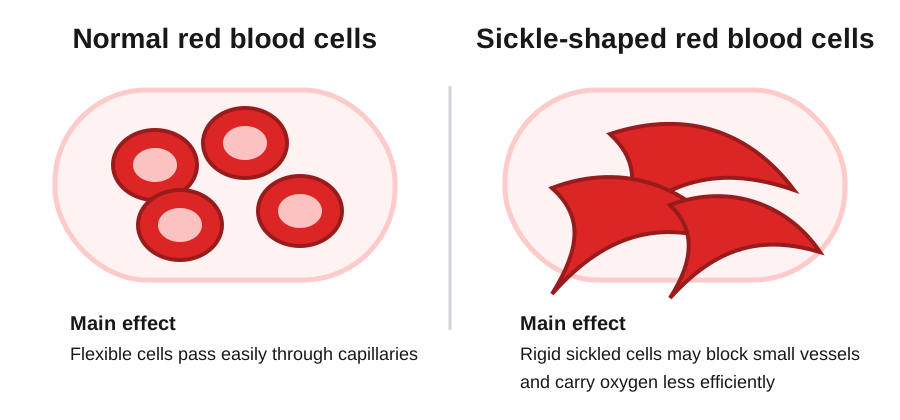
Sickle-cell anaemia is caused by a mutation in the haemoglobin gene. Red blood cells distort into a sickle shape under low-oxygen conditions, obstructing blood vessels and reducing oxygen delivery. Heterozygous carriers have one normal and one mutated allele — they do not have the disease but gain resistance to malaria. This explains why the sickle-cell allele persists in regions where malaria is common: carriers have a selective advantage.
Down's syndrome is caused by trisomy 21 — a chromosomal mutation resulting in three copies of chromosome 21 instead of two. It affects physical development and cognitive ability.
Mutagenic Agents
Mutagens are factors that increase the rate of mutation above background levels.
Mutagenic agents
| Type | Examples |
|---|---|
| Radiation | Ultraviolet (UV) light, X-rays, gamma rays |
| Chemical | Nitrosamines, mustard gas, benzene |
The Species Concept and Speciation
Defining a Species
A species is a group of closely related organisms that can interbreed and produce fertile offspring. This is the biological species concept.
Key implications:
- Members of the same species share compatible reproductive mechanisms
- When individuals from different species mate, offspring are usually non-viable (do not survive) or infertile — for example, a mule is the offspring of a horse and a donkey; it survives but is sterile
- Species that live in the same habitat but do not interbreed remain distinct
How New Species Form (Speciation)
Speciation is the process by which one species splits into two or more distinct species. It requires populations to become reproductively isolated — unable to interbreed — for long enough that they accumulate different genetic changes.
Two main mechanisms:
1. Geographic (allopatric) speciation — a physical barrier separates a population:
Examples: colonising a new island; a river changing course; a mountain range rising.
2. Ecological (sympatric) speciation — populations share a habitat but become separated by behavioural or ecological differences, such as:
- differences in courtship behaviour or mating calls
- differences in feeding preferences or breeding season timing
- differences in coloration leading to selective mating
Over time, even without a physical barrier, populations that do not interbreed diverge genetically.
Extinction
Species can also be lost. Causes of extinction include:
- habitat destruction
- hunting and overexploitation
- introduction of invasive species
- disease
Example: the Caribbean Monk Seal was driven to extinction by hunting and habitat loss.
Exam Tip
The key to speciation is reproductive isolation — populations that cannot interbreed accumulate different mutations and face different selection pressures, gradually diverging. A common exam question asks you to distinguish between geographic and ecological speciation or to explain how a mule illustrates the species concept.
Artificial Selection
Artificial selection is the deliberate breeding of organisms with traits chosen by humans. The selecting agent is human preference rather than environmental pressure, which makes it much faster than natural selection — but it often reduces genetic diversity.
Natural selection vs artificial selection
| Feature | Natural Selection | Artificial Selection |
|---|---|---|
| Selecting agent | Environment | Humans |
| Purpose | Survival and reproduction | Human-desired traits |
| Speed | Very slow (many generations) | Relatively rapid |
| Effect on genetic diversity | Maintains it | Often reduces it |
Plant breeding: A high-yield variety may be crossed with a disease-resistant one to produce offspring combining both traits. Modern crop varieties have been produced this way.
Animal breeding: Cattle selected for milk yield, dogs bred for specific working or aesthetic traits, chickens bred for rapid growth.
Genetic Engineering
Genetic engineering is the direct manipulation of an organism's DNA — typically by isolating a gene from one species and transferring it to another. The recipient is called a transgenic organism.
Applications of genetic engineering
| Application | Example |
|---|---|
| Medicine | Bacteria engineered to produce human insulin for diabetics |
| Agriculture | Crops with built-in pest or herbicide resistance |
| Nutrition | Golden Rice engineered to produce beta-carotene (vitamin A) |
Concerns about genetic engineering
| Concern | Detail |
|---|---|
| Health | Potential allergens introduced into GM foods |
| Environment | Modified genes may transfer to wild plant populations |
| Economic | Small farmers may become dependent on large corporations |
| Ethical | Concerns about manipulation of life at the genetic level |
Exam Tip
When asked about genetic engineering, give specific examples rather than vague statements. "Bacteria produce insulin" is more credible than "it can be used in medicine." For concerns, explain the mechanism — "genes could transfer to wild plants, creating herbicide-resistant weeds" is stronger than "it could harm the environment."