Market Structures
Matthew Williams
||9 min readCSEC EconomicsMarket StructureMonopolistic CompetitionMonopolyOligopolyPaper 01Paper 02Perfect CompetitionSection 4
Definition and characteristics of market structures, perfect competition, monopoly, monopolistic competition, and oligopoly: features, barriers to entry, short-run and long-run equilibrium, and advantages and disadvantages.
A market structure describes the characteristics of a market that determine how firms compete and what power they have over prices. The key dimensions are: the number of firms, the type of product, freedom to enter and exit, and the degree of price control.
The Four Main Market Structures
Comparing the Four Structures
| Feature | Perfect Competition | Monopolistic Competition | Oligopoly | Monopoly |
|---|---|---|---|---|
| Number of firms | Very many | Many | Few (large) | One |
| Type of product | Identical (homogeneous) | Differentiated | Standardised or differentiated | Unique |
| Control over price | None (price taker) | Some | Significant | Full (price maker) |
| Barriers to entry | None | Low | High | Very high |
| Long-run profit | Zero (normal profit only) | Zero (normal profit only) | Possible supernormal | Possible supernormal |
| Examples | Agricultural commodities, some forex markets | Restaurants, hairdressers, clothing retail | Airlines, mobile networks, oil companies | Water utilities, national electricity grids |
Perfect Competition
In a perfectly competitive market, no single buyer or seller can influence the price. The market price is set by the interaction of the industry's demand and supply, and each firm accepts it — they are price takers.
Conditions for perfect competition:
- Very many buyers and very many sellers
- Identical (homogeneous) products — no product differentiation
- Perfect information — all buyers and sellers know the prevailing price
- Perfect mobility of factors — resources can freely enter or exit any industry
- No barriers to entry or exit
Because the firm cannot influence price, its demand curve is a horizontal line at the market price — perfectly elastic. The firm sells as much or as little as it chooses at that price.
Short-run equilibrium: A firm maximises profit by producing where MC = MR (marginal cost equals marginal revenue). In the short run, the firm may earn supernormal profit if market price exceeds average total cost, or make a loss if price is below ATC. If price is between AVC and ATC, the firm continues to produce in the short run to minimise losses.
Long-run equilibrium: Supernormal profit attracts new firms into the industry, increasing supply and driving the price down until only normal profit remains. Losses cause firms to exit, reducing supply and raising price back up. In the long run, price equals minimum ATC and profits are zero.
Advantages: Allocative and productive efficiency are achieved — resources are directed to their most valued use and production occurs at the lowest possible cost. Consumers benefit from low prices.
Disadvantages: Rarely exists in practice. No incentive or resources for research and development. Assumes a level of homogeneity and information that does not exist in real markets.
Monopolistic Competition
Monopolistic competition combines elements of both perfect competition and monopoly. Many firms compete, but each sells a differentiated product, giving it a small degree of price-setting power.
Characteristics:
- Many firms, each with a relatively small market share
- Products are differentiated by brand, quality, location, or packaging (non-price competition)
- Low barriers to entry and exit
- Some control over price in the short run, due to product differentiation
Short-run equilibrium: Like a monopolist, the firm faces a downward-sloping demand curve (because its product is not identical to rivals'). It sets MC = MR and can earn supernormal profit.
Long-run equilibrium: The ease of entry attracts rivals. As new firms introduce similar differentiated products, demand for each existing firm falls until only normal profit remains. The long-run equilibrium has some excess capacity — firms produce below their minimum ATC.
Advantages: Variety of products gives consumers choice. Competition prevents extreme price exploitation. Innovation in product design and quality is encouraged.
Disadvantages: Some inefficiency because firms produce on the downward slope of the ATC — not at minimum cost. Advertising expenditure may be wasteful.
Oligopoly
An oligopoly is a market dominated by a small number of large firms. Firms are highly interdependent — any price or output decision by one firm affects the others, who will react.
Characteristics:
- Few large firms controlling a significant share of total supply
- High barriers to entry (economies of scale, capital requirements, brand loyalty, patents)
- Products may be homogeneous (e.g. oil) or differentiated (e.g. cars)
- Significant control over price; firms tend to avoid price competition to prevent price wars
- Interdependence is the defining feature — firms watch and react to each other
Price rigidity: Prices in oligopolistic markets tend to be sticky. If one firm raises its price, others do not follow, so demand drops sharply. If one firm lowers its price, others match the cut to avoid losing market share, so little extra demand is gained. This creates an incentive to keep prices stable.
Collusion: Firms may collude — formally (a cartel) or informally — to fix prices, restrict output, and maximise collective profits. Formal cartels are illegal in most countries because they eliminate competition.
Barriers to entry in oligopoly:
- Economies of scale — existing firms have lower costs than any new entrant
- High capital investment requirements (start-up costs)
- Established brand loyalty
- Patents and proprietary technology
- Predatory pricing — incumbents temporarily cut prices to drive out new entrants
Advantages: Economies of scale allow lower average costs and sometimes lower prices. Investment in R&D is possible with supernormal profits.
Disadvantages: Price-fixing and collusion harm consumers. Less competition reduces incentives for efficiency. Barriers prevent new, potentially innovative firms from entering.
Monopoly
A pure monopoly exists when a single firm is the only producer of a good or service with no close substitutes, and significant barriers prevent entry.
Characteristics:
- One firm dominates the entire market
- A unique product with no close substitutes
- Very high barriers to entry
- Firm is a price maker — it sets the price and consumers either pay or go without
- Downward-sloping demand curve (= the industry demand curve)
Barriers to entry in a monopoly:
- Legal/patent protection — exclusive rights to produce a product or use a technology
- Natural monopoly — economies of scale so great that only one firm can profitably serve the market (e.g. water supply, national electricity grid)
- Control of key resources — one firm owns all of an essential input
- High capital requirements — enormous start-up costs deter new entrants
- Government licence — only one firm is legally permitted to operate (e.g. national postal service)
Short-run and long-run equilibrium: The monopolist produces where MC = MR. Because the demand curve slopes downward, MR lies below AR (price). The monopolist can maintain supernormal profits in the long run because barriers prevent entry. There is no such thing as a monopolist's supply curve in the traditional sense — it is a price-and-quantity decision made together.
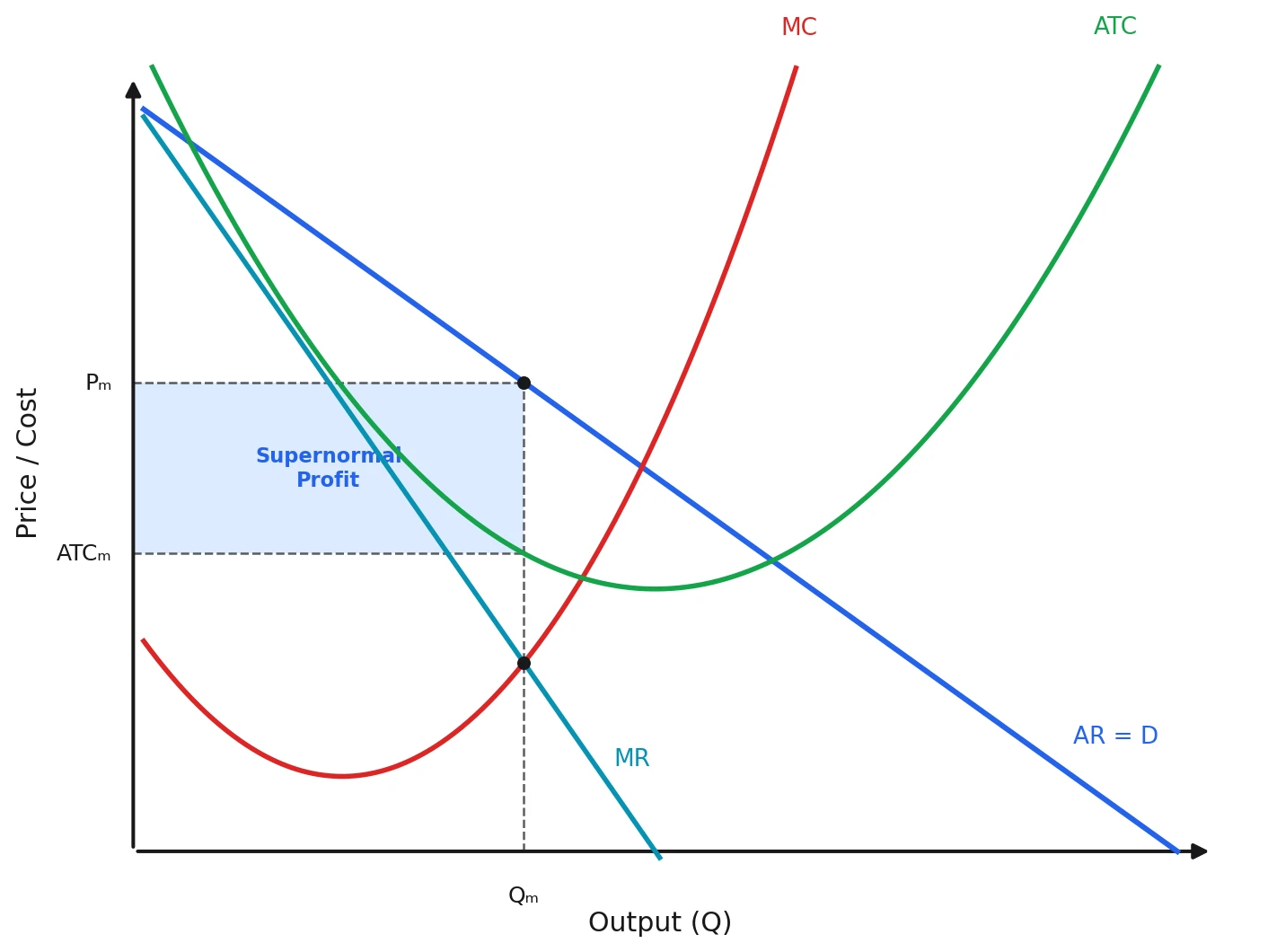
Advantages: Can fund large-scale R&D with supernormal profits. A natural monopoly is more efficient than having duplicate infrastructure (e.g. two sets of water pipes). Economies of scale may result in lower prices than if many small firms competed.
Disadvantages: Higher prices and lower output than a competitive market. No incentive for efficiency — the lack of competition allows the firm to be complacent. Income is redistributed from consumers to shareholders. May produce at a point that is neither allocatively nor productively efficient.
Exam Tip
In Paper 02, a question on market structures will typically ask you to: describe characteristics, draw and interpret a diagram, and discuss advantages or disadvantages. Always connect characteristics to behaviour — for example, high barriers to entry in a monopoly explain why supernormal profit persists in the long run.