Radioactivity
Matthew Williams
||10 min readAlphaBetaCSEC PhysicsGammaHalf-LifeNuclear EquationsPaper 01Paper 02RadioactivitySection E
Alpha, beta, and gamma radiation properties (charge, mass, penetration, ionisation), nuclear equations, the random nature of decay, half-life (definition, graphs, calculations), and applications of radioisotopes.
Marie Curie and the Discovery of Radioactivity
Marie Curie (1867-1934) was a pioneering physicist and chemist who conducted systematic research into radioactivity, a term she coined. Working with her husband Pierre Curie, she discovered two new radioactive elements: polonium (named after her homeland Poland) and radium. She was the first person to win two Nobel Prizes, in Physics (1903) and Chemistry (1911). Her work established that radioactivity is a property of the atom itself, not a chemical reaction, and laid the foundation for nuclear physics and radiation medicine.
Radioactive decay is the spontaneous emission of radiation from an unstable nucleus. The process is random, it is impossible to predict when any particular nucleus will decay, but for a large sample, the average rate of decay follows a predictable exponential pattern.
Just in Case
Isotopes are atoms of the same element that have the same proton number (atomic number) but different mass numbers (different numbers of neutrons). For example, Carbon-12 and Carbon-14 are both isotopes of carbon.
Background radiation is the low-level radiation present at all times from natural sources (cosmic rays, rocks, soil, radon gas) and artificial sources (medical/industrial). Count rates in experiments must be corrected by subtracting the background count rate.
The becquerel (Bq) is the SI unit of radioactivity: 1 Bq = 1 nuclear disintegration per second.
A radioisotope (radioactive isotope) is an isotope of an element that has an unstable nucleus and spontaneously emits radiation (alpha, beta, or gamma) as it decays toward a more stable state. Not all isotopes are radioactive — Carbon-12 is stable, while Carbon-14 is a radioisotope.
The Three Types of Radiation
| Property | Alpha () | Beta () | Gamma () |
|---|---|---|---|
| Nature | Helium-4 nucleus () | Fast electron | High-energy electromagnetic wave |
| Charge | +2 | −1 | 0 |
| Mass (relative) | 4 | ~0 | 0 |
| Speed | Slow (~5% of ) | Fast (up to ~90% of ) | (speed of light) |
| Ionising ability | Very high (dense ionisation) | Medium | Low |
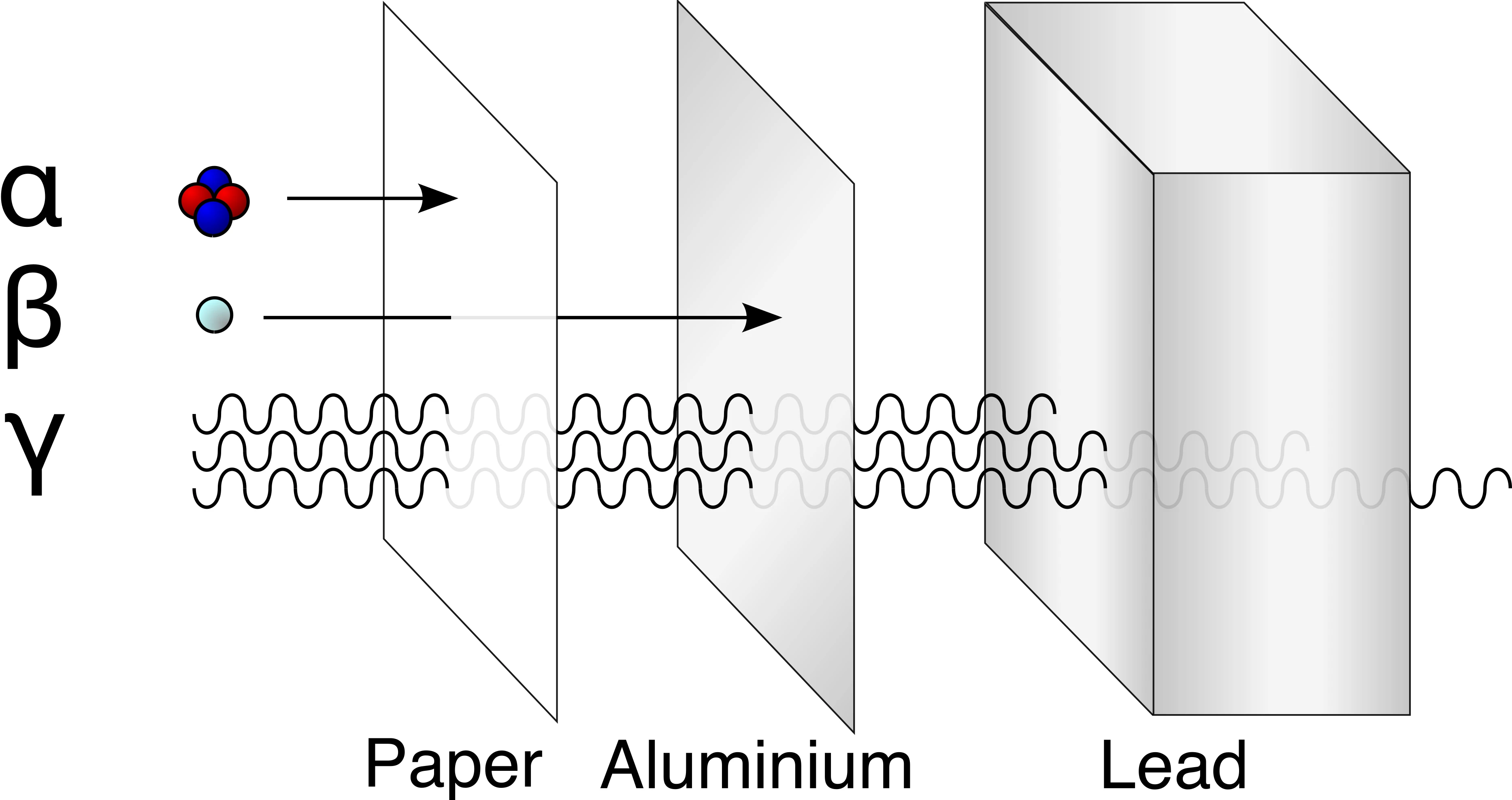
| Penetrating ability | Stopped by 5 cm of air or a sheet of paper | Stopped by 3-5 mm of aluminium | Reduced by several cm of lead or metres of concrete |
| Deflection by electric field | Toward negative plate | Toward positive plate | Not deflected |
| Deflection by magnetic field | Yes (using left-hand rule for positive charge moving) | Yes (in opposite direction to alpha) | Not deflected |
Comparing Ranges Experimentally
A Geiger-Müller (G-M) tube connected to a counter is used to measure the count rate from each source.
Range in air: The source is moved to increasing distances from the G-M tube. The count rate is recorded at each distance (corrected for background radiation). The range in air is the distance at which the corrected count rate drops to zero.
Range in materials: The source is held at a fixed, short distance from the G-M tube. Different thicknesses of absorbing material are placed between the source and tube. The range in that material is the thickness that just reduces the corrected count rate to zero.
Results confirm:
- Alpha is stopped by a few centimetres of air or a single sheet of paper.
- Beta is stopped by 3 to 5 mm of aluminium.
- Gamma has no definite range; the material thickness that halves the beam intensity is used instead (~1 cm of lead halves a gamma beam).
Cloud Chamber Tracks
A cloud chamber makes the paths of radiation visible as trails of condensed vapour. The appearance of each track reflects the nature of the radiation:
| Radiation | Track appearance |
|---|---|
| Alpha () | Thick, short, straight tracks — heavy particle, high ionisation, quickly stopped |
| Beta () | Thin, longer, irregular (curved) tracks — lighter particle, less ionisation, deflected more easily |
| Gamma () | No visible track — gamma is not charged and does not ionise directly; it may cause secondary electrons that produce faint, wispy traces |
Nuclear Equations
In a nuclear equation, both the mass number (A) and the atomic number (Z) must be conserved.
Alpha Decay
An alpha particle () is emitted. A and Z both decrease:
Example: Ra-226 undergoes alpha decay:
Beta Decay
A beta particle (electron, ) is emitted. A stays the same; Z increases by 1 (a neutron converts to a proton):
Gamma Emission
A gamma ray () is emitted. A and Z are unchanged, only the nucleus loses energy.
Half-Life
The half-life () of a radioactive substance is the time taken for the activity (or the number of undecayed nuclei) to fall to half of its initial value.
Half-life is a characteristic of each isotope and does not change with temperature, pressure, chemical form, or sample size.
After half-lives, the fraction of activity remaining is .
ExampleHalf-life from a graph (2016 Paper 02, Q1)
Activity data for a sample:
| Time (h) | Activity (disintegrations/s) |
|---|---|
| 0 | 80.0 |
| 1 | 50.0 |
| 2 | 34.5 |
| 3 | 20.0 |
| 4 | 13.0 |
| 5 | 7.5 |
| 6 | 5.0 |
From the smooth decay curve: activity falls from 80 to 40 between and approximately h. Activity falls from 40 to 20 between h and h.
Both intervals give approximately the same half-life: h.
Time for activity to reach 10 disintegrations/s: Read from the graph, at , h.
The decay is not a perfectly smooth curve because radioactive decay is random, individual decays occur by chance, producing statistical fluctuations in the measured activity.
Demonstrating the Random Nature of Decay
A G-M tube connected to a counter shows this directly: the counter advances irregularly — sometimes quickly, sometimes with a gap — even when the source and distance remain unchanged. You cannot predict exactly when the next count will occur.
A card analogy illustrates the same idea: if you repeatedly draw one card from a shuffled set and record whether a specific card (e.g. the queen of spades) is drawn, the results are irregular for any single trial. Over many trials, however, the average frequency matches the theoretical probability. Similarly, you cannot predict which nucleus in a sample will decay next, but the overall decay rate of a large sample is predictable and follows the exponential half-life pattern.
ExampleHalf-life from count rate, no graph (2024 Paper 02, Q6d)
A radioactive isotope has an initial count rate of 16 000 counts per minute. After 100 seconds the count rate has fallen to 1 000 counts per minute. Calculate the half-life of the isotope.
Number of half-lives elapsed:
Count each successive halving from 16 000 down to 1 000:
| Step | Count rate |
|---|---|
| Start | 16 000 |
| 1 half-life | 8 000 |
| 2 half-lives | 4 000 |
| 3 half-lives | 2 000 |
| 4 half-lives | 1 000 |
Four halvings, so half-lives have passed in 100 s.
Half-life:
Applications of Radioisotopes
| Application | Radioisotope used | Reason for choice |
|---|---|---|
| Medical imaging (thyroid scan) | Iodine-123 (I) | Absorbed by thyroid; short half-life minimises patient dose |
| Cancer treatment (radiotherapy) | Cobalt-60, gamma knife | High-energy gamma kills tumour cells |
| Carbon dating | Carbon-14 (C), half-life 5730 years | Living organisms maintain constant C-14 level; ratio to C-12 decreases after death |
| Industrial thickness gauging | Beta emitters | Absorption through material gives thickness measurement |
| Sterilisation of medical equipment | Gamma sources | Gamma penetrates packaging to kill bacteria |
Exam Tip
In a half-life calculation: if the activity falls to 1/16 of its original value, that is , so four half-lives have passed. Divide the total elapsed time by 4 to find one half-life.
In nuclear equations, check both the top numbers (A) and the bottom numbers (Z) balance on each side. The most common error is forgetting to adjust Z when writing the daughter nucleus.